

Kelley Blue Book celebrates its 100th anniversary this year. As we reflect on a century of influence on the automotive landscape, it stands out that cars have had a significant effect on our culture. One place we can track this effect is in automotive advertising.
I’ve always been a media hound, and I love advertising, where art, commerce, and culture collide. I’ve selected one ad from each decade of the past century that I believe sent ripples through popular culture. See if my choices resonate with you — and if you remember other car ads that stuck with you beyond their blatant sales pitches.
1920s
Packard: Ask the Man Who Owns One
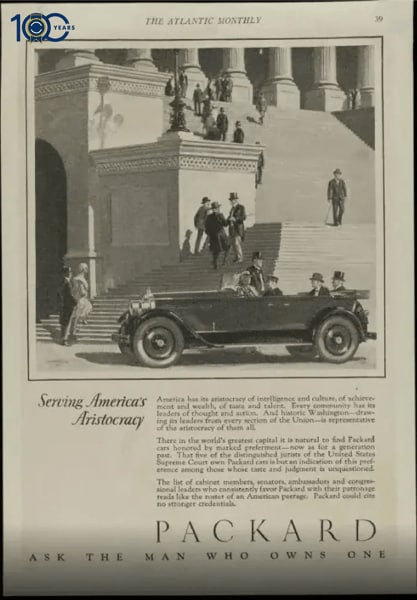
Sure, the gendered message hasn’t aged well, but this early callout for crowdsourcing encourages shoppers to seek out ratings from their peers. I’ll bet the Packard marketing department would have loved Reddit and other web communities if they had been in business today. Unfortunately, Packard built its last cars in 1956, and the luxury brand disappeared in 1958. This ad from 1926, the same year Kelley Blue Book debuted, carries the inspired motto that lasted almost as long as Packard did.
1930s
Cadillac: The Standard of the World
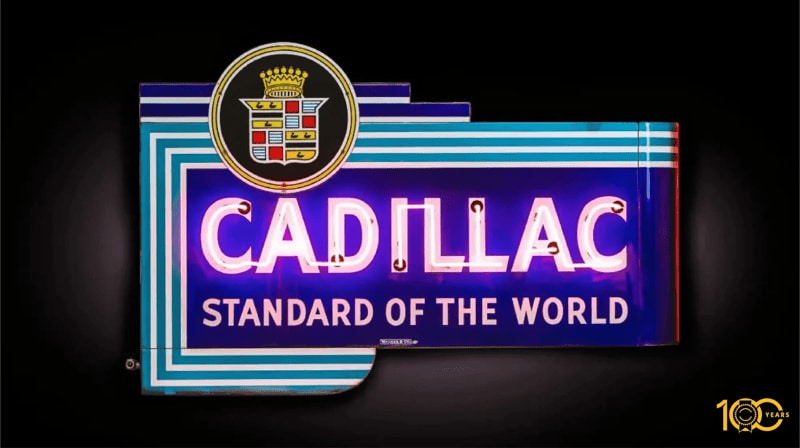
Before they had a real right to, Cadillac’s advertising department proclaimed the luxury brand was “The Standard of the World.” Remember, this was at a time when brands like Rolls-Royce, Bentley, Bugatti, and Talbot-Lago were in production. The bold branding worked for Cadillac, even spawning the claim in other industries, “It’s the Cadillac of (fill in the blank).” Who can forget when Chilli Palmer defends his Oldsmobile Silhouette in 1995’s “Get Shorty” with, “It is the Cadillac of minivans.”
1940s
Ford: Watch the Fords Go By
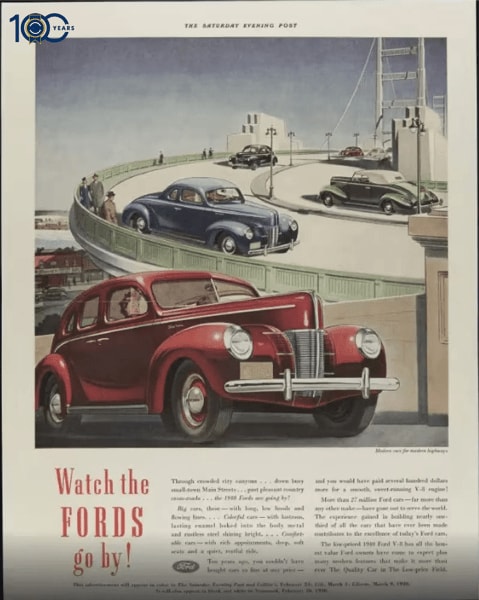
In 1940, the United States was just emerging from the Great Depression, and another World War was brewing in Europe. Ford’s savvy advertising team recognized the country’s unsettled mood and struck just the right note with the slogan, “Watch the Fords Go By.” It was a subtle nod to isolationist sentiment, while beaming with optimism and a small-town feel. A few years later, everything would change for the country, the auto industry, and the world. Ford captured a bittersweet moment.
1950s
Chevrolet: See the USA in Your Chevrolet
In sharp contrast to the bittersweet 1940s, the 1950s were all about energy, growth, and movement. Television and in-theater advertising were ramping up, and Chevrolet engaged one of America’s brightest singing stars, Dinah Shore, to endorse their brand with a memorable jingle, “See the USA in Your Chevrolet.” Celebrities had appeared in print ads before, but this filmed ad made a broad impression on a wide audience. It’s an earworm, and it really makes you want to travel.
1960s
Pontiac: Here Comes the Judge!
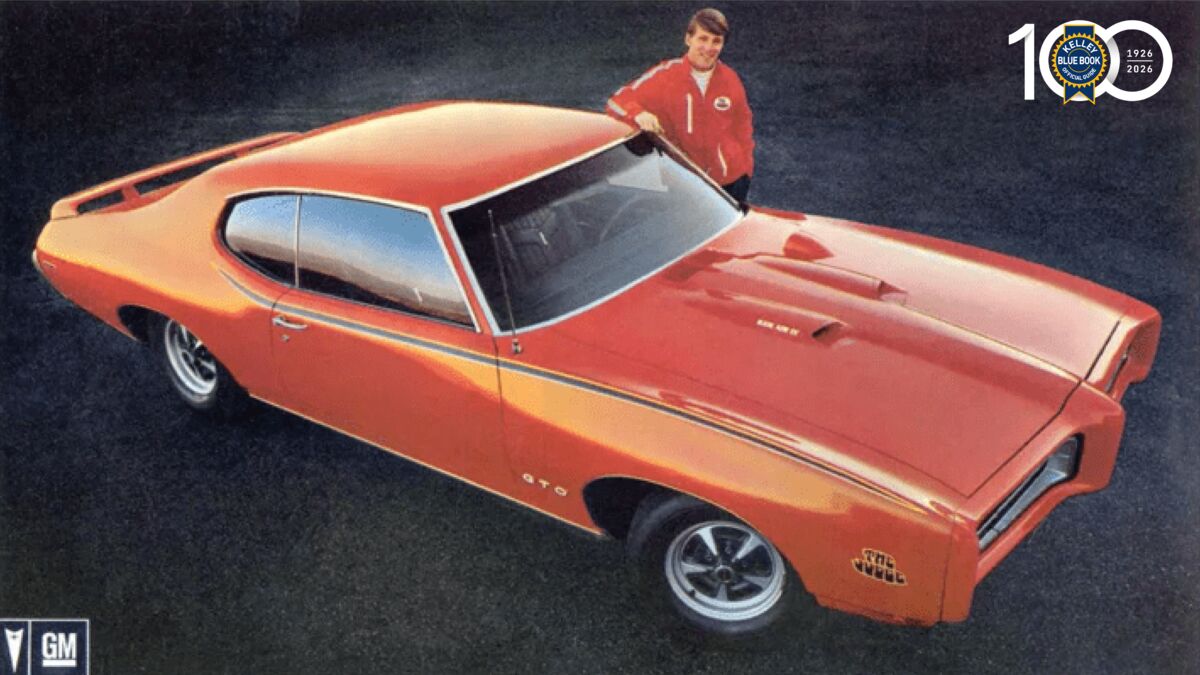
This ad is one of the few I can think of that a piece of culture inspired and reflected back and forth. The Judge was a variant of the 1969 Pontiac GTO. It used a mod logo on the front quarter panel, very late ‘60s. Very cool, and there’s a backstory.
Pigmeat Markham, a comedian, put out a single in 1968, “Here Comes the Judge.” Some musicologists say it’s the first rap single, but, as Andrew Hickey always says in his “A History of Rock Music in 500 Songs” podcast, there’s no such thing as “first” in music. Despite being on the verge of outsider art, Markham’s song caught on with the hippest television show on the planet, “Rowan & Martin’s Laugh In,” and soon, guest stars like Sammy Davis Jr. were dressing up in judge’s robes and chanting, “Here comes the judge, here comes the judge. Order in the court, ‘cause here comes the judge,” as they entered a sketch comedy scene. Pontiac took advantage of the phrase’s popularity, and a great ad campaign was born. Today, we’d probably witness squabbles over intellectual property (IP), but the 1960s were a simpler time.
Pigmeat Markham’s single, “Here Comes the Judge.”
A Pontiac television commercial for The Judge, featuring Paul Revere and the Raiders.
1970s
Chevrolet: Wagons
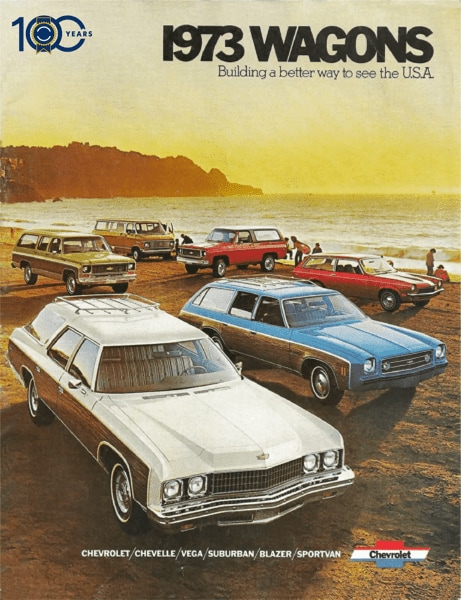
I hate the word “iconic.” It’s used so much these days that it has lost its meaning. Still, I have a hard time finding a better word for the station wagon’s stature in 1970s culture.
While today’s automakers and marketers do everything they can to avoid saying “wagon” when they describe their long-roof vehicles, in this 1973 brochure, Chevrolet leans into the term — hard. With an echo of Dinah Shore, the brochure is entitled, “1973 Wagons: Building a better way to see the U.S.A.” The company touts six wagon models from its lineup: Chevrolet, Chevelle, Vega, Suburban, Blazer, and Sportvan. Since it’s 1973, four of the six wagons wear wood-look siding. Bring back the wagon, I say!
1980s
Honda: We Make It Simple
The first imported brand to make our list, Honda, and other Japanese manufacturers gained a toehold in the U.S. in the wake of the 1973 to 1974 gas crisis. An oil embargo by the Organization of Arab Petroleum Exporting Countries (OAPEC) created nationwide gas shortages, leading to a surge in interest in fuel-efficient compact and subcompact cars. Honda was already building them and exporting its models here. The Civic debuted in the U.S. in 1973 and has been a strong seller here ever since.
In 1981, Honda introduced the slogan, “We Make It Simple” in a television ad that ends with a 7-note jingle that rang through its advertising for years thereafter. And it didn’t hurt to have the voice of Burgess Meredith (Mickey, the trainer in “Rocky”) narrating the elemental visuals.
1990s
Volkswagen: Fahrvergnügen
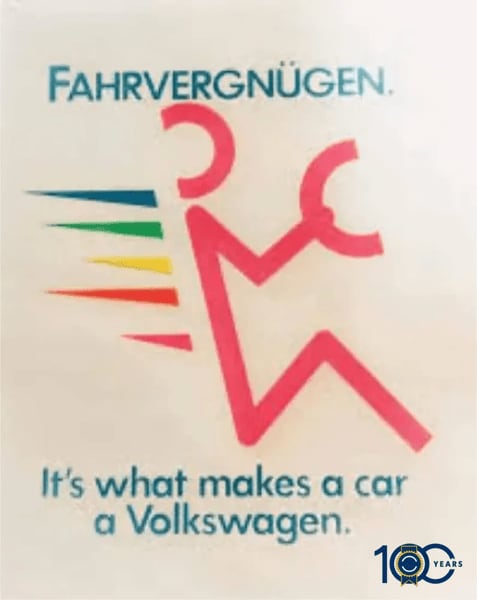
If ever a car word became a fad, it was Fahrvergnügen. Volkswagen claimed it meant, “The pleasure of driving.” I’ve never been able to confirm that with a native German speaker. VW promoted the concept with television and print ads, and soon the stick-figure behind-the-wheel graphic was everywhere in the early 1990s, with multiple variants, parodies, and rip-offs.
A European television ad, featuring a Princess Diana lookalike and a Prince soundalike (or maybe it is Prince — I don’t know for sure), enhanced the fun of the campaign. Fahrvergnügen didn’t have much staying power, but it certainly burned bright in its moment.
2000s
Dodge: “That thang got a Hemi?”
The return of the Hemi V8 engine in the 2003 Dodge Ram Heavy Duty pickup truck sounded the battle cry for the new muscle-car wars. The first skirmishes took place in the 1960s and into the early 1970s, mostly confined to pony cars like the Ford Mustang, Chevrolet Camaro, and Dodge Charger. The 21st-century muscle-car wars raged among the coupes and sedans, but this time, pickup trucks and SUVs sprouted mega-horsepower engines, too. Americans seemed to have forgotten about fuel economy. They fell in love with muscle, and they went head-over-heels for big pickups.
Comedian Jon Reep launched his career with his rural-accented cry of “That thang got a Hemi?” in a series of commercials that ran from 2004 to 2007. The call from amateur imitators has taunted Hemi drivers ever since.
2010s
Kia: Not Your Average Dunk. Not Your Average Midsize Sedan.
Sports and culture have intermingled, maybe never more than in the National Basketball Association. Blake Griffin was a rising star for the Los Angeles Clippers when he chose to leap over a 2011 Kia Optima sedan during the Slam Dunk Contest during NBA All-Star Week on Feb. 11, 2011. The stunt catapulted the young player to fame, and Kia used a slow-motion video of the event as a commercial. It was the dunk that launched a thousand Optimas — maybe more.
2020s
Hyundai: Smaht Pahk
The acorn planted by Dinah Shore grew into a mighty oak in the 2020s, as celebrity appearances in advertising flourished across the media landscape. Even when famous faces don’t appear in ads, you’ll recognize famous voices everywhere: Bryan Cranston for Ford; Will Arnett for GMC; Matthew McConaughey for Lincoln (he shows his face, too).
Two recent ads bubble to the top for their celebrity ingredients, though.
Hyundai’s star-studded promotion of its automatic parking system, Smart Park, features stars with Boston roots. The 2020 Sonata spot, shot in and around what looks like Boston, plays on the Boston accent as Chris Evans (“Captain America”), Rachel Dratch (“Saturday Night Live”), and John Krasinski (“The Office”) holler at each other about “Smaht Pahk.” They pipe down when David Ortiz, aka Big Papi, of the Boston Red Sox, sticks his head out of an apartment window. The guitar riff from the ultimate Boston song, “Muddy Water” by the Standells, underscores Jason Bateman’s voiceover ending.
2020s Bonus
Jeep: Groundhog Day
Jeep outdoes Kia with its 2020 commercial for the Jeep Gladiator. It’s a virtual sequel to the 1993 movie “Groundhog Day.” Both the film and the commercial star Bill Murray. I could stop right there, but the ad also includes Stephen Tobolowski (Ned Rierson), Brian Doyle Murray (the Mayor), and Punxsutawney Phil — a real live groundhog.
Where will car advertising and culture go next?