

Quick Tips About End of Car Lease Options
- When your lease ends, you can return the car, buy it, buy it and then sell or trade it, or ask the leasing company whether it will offer a lower buyout price.
- Compare your lease payoff quote with the car’s current market value before deciding what to do.
- If the car is worth more than the payoff amount, you may have equity you can capture by buying and then selling or trading the vehicle.
- If the car is worth less than the payoff amount, returning it is often the less expensive choice.
- Extending or transferring a lease may also be possible, depending on your leasing company and contract.
When your car lease is about to end, don’t automatically hand over the keys or assume that buying the vehicle is your best option. Start by finding out two numbers: What it will cost to buy the car and what the car is worth today.
Your buyout price was largely established when you signed the lease, but market conditions can change significantly during a two- or three-year lease. That difference can determine whether you should return the car, buy it, or potentially buy it and then sell or trade it.
Here’s how to evaluate your end-of-lease options.
Your Options When a Car Lease Ends
Most lessees have several possible paths when the contract expires.
| Option | When It Might Make Sense | What to Watch For |
|---|---|---|
| Return the car | The vehicle is worth less than the buyout price, or you simply want another car | Excess mileage, wear-and-tear charges, and disposition fees |
| Buy the car | You like the vehicle and the buyout price compares favorably with its market value | Taxes, fees, financing costs, and the vehicle’s condition |
| Buy, then sell or trade it | The car is worth more than your total buyout cost | Taxes, title timing, fees, and restrictions on third-party buyouts |
| Ask about a lower buyout price | The car’s market value has fallen below the contracted residual | The residual itself generally remains fixed; any discount comes from the lessor |
| Extend the lease | You need more time before getting another vehicle | Continued payments, mileage limits, and extension terms |
| Transfer the lease | Your contract allows it and another person is willing to assume the lease | Lender restrictions, transfer fees, and remaining liability |
Before choosing your course, determine what it would actually cost to own the vehicle.
MORE: Car Leasing Guide: How to Lease a Vehicle
Find Your Real Lease Buyout Price
Your residual value and your payoff quote are related, but they are not necessarily the same number.
The residual value appears in your lease contract. It is the estimated value of the vehicle at the end of the lease and generally forms the basis of the purchase price if you exercise the purchase option.
Your payoff quote is the amount the leasing company says you must pay to purchase the vehicle now. Depending on the contract and where you live, the total cost can include:
- The residual value
- Any remaining lease payments
- A purchase-option fee
- Sales tax
- Registration and title fees
- Other charges permitted by the lease
Contact the leasing company directly and ask for the current payoff amount and an itemized explanation of any fees. Don’t rely solely on a dealer’s buyout quote. A dealer may include additional fees or charges above what the leasing company requires.
Is Your Lease Buyout a Good Deal?
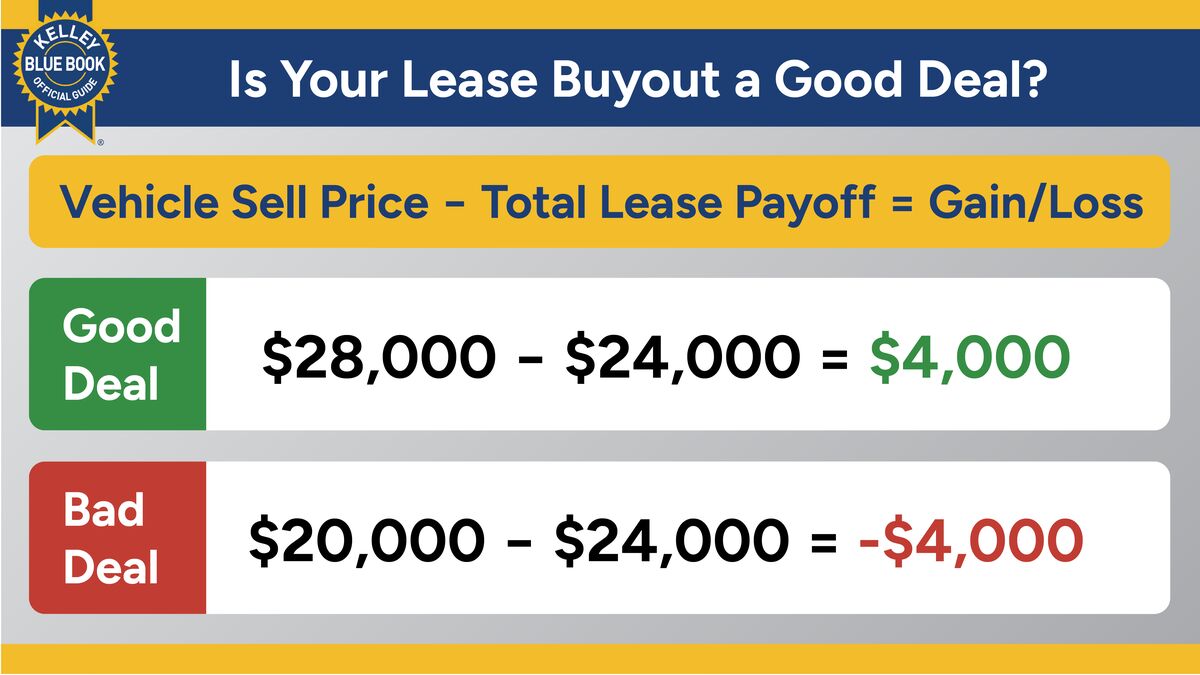
Once you know the payoff amount, compare it with your car’s current market value.
Use the Kelley Blue Book car value tool to see what your vehicle may be worth as a trade-in and in a private-party sale. Be accurate about mileage, condition, trim level, equipment, and location.
For example, suppose your total lease payoff is $24,000.
If similar vehicles are worth around $28,000, you may have roughly $4,000 in potential equity before accounting for taxes, fees, and selling costs.
If the vehicle is worth only $20,000, paying $24,000 to buy it probably makes less financial sense unless there is another reason you particularly want to keep the car.
This comparison has become especially important as vehicles leased during very different market conditions reach the end of their contracts. Cox Automotive’s June 2026 Mid-Year Review found that gasoline and conventional hybrid leases still generally carried positive equity, while EVs and plug-in hybrids were underwater.
RELATED: Best Lease Deals Around $200
If Your Car Is Worth More Than the Buyout
If your vehicle’s market value exceeds what it will cost you to purchase it, you may have positive equity.
One option is to buy the car and keep it. If you already know its maintenance history, like the vehicle, and can purchase it for less than a comparable used model would cost, a buyout can be appealing.
Another option is to capture the equity by buying the vehicle and then selling or trading it.
For example, if your total buyout cost is $24,000 and a dealer is willing to give you $27,000 for the vehicle, the difference could represent equity you can apply toward another car.
However, don’t assume you can simply sell your leased car directly to any dealership or online car buyer. Some leasing companies restrict third-party lease buyouts. In that situation, you may have to purchase and title the car before selling it, which can introduce sales taxes, title-processing time, and other costs that reduce or eliminate the potential profit. Check with your leasing company before making plans.
If Your Car Is Worth Less Than the Buyout
If the payoff is higher than the vehicle’s market value, returning the car will often make more financial sense than purchasing it.
Suppose your payoff is $28,000 but the vehicle is worth only $23,000. Buying the car would mean paying about $5,000 more than its current value before considering taxes, registration, or financing.
That doesn’t automatically mean you should return it. You might prefer to keep a vehicle you know rather than shopping for another used car. You also may face excess-mileage or wear charges when turning in the lease.
But the gap between market value and payoff gives you an important starting point.
In some cases, an automaker or leasing company may offer an incentive or discounted buyout when the vehicle’s market value has fallen substantially below its contractual residual value. Ask the lessor whether any lease-end purchase incentives are available before returning the vehicle.
Can You Negotiate a Lease Buyout?
You can sometimes negotiate a lease buyout, but it’s important to understand what can and cannot change.
The residual value in your original lease contract generally does not change. You are not renegotiating that number.
However, the leasing company may offer or agree to a lower lease-end purchase price, particularly when the vehicle’s market value has fallen significantly below the residual value. Automakers also occasionally offer lease-buyout incentives.
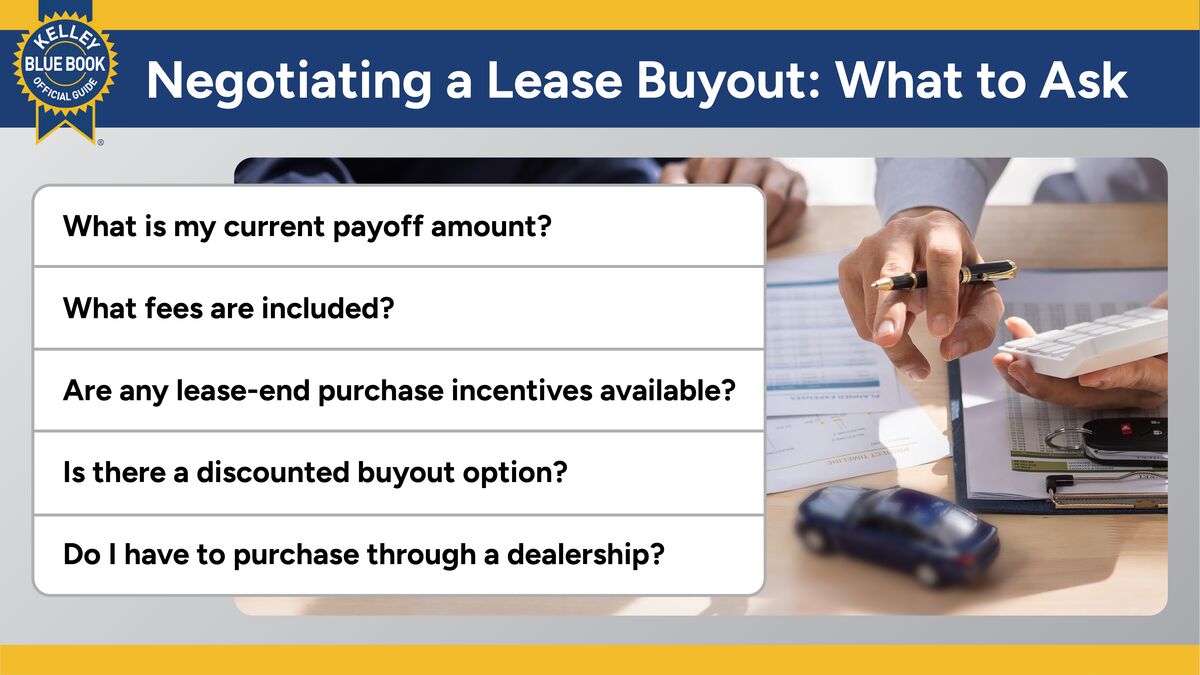
Start by contacting the leasing company directly and ask:
- What is my current payoff amount?
- What fees are included?
- Are any lease-end purchase incentives available?
- Is there a discounted buyout option?
- Do I have to complete the purchase through a dealership?
Also distinguish between charges from the leasing company and charges added by a dealer. If a dealership quotes a buyout price higher than the lessor’s payoff amount, ask for an itemized explanation of the difference.
RELATED: Car Negotiation Playbook and Strategy
How to Pay for a Lease Buyout
If you decide to purchase your leased car, you can pay cash or finance the buyout.
Paying cash eliminates interest expense, but many buyers will need a loan. Lease-buyout loans are generally treated more like used-car loans than new-car financing.
Before arranging financing through a dealership, check rates with banks and credit unions and consider getting preapproved. Shopping for financing separately gives you a benchmark for evaluating any loan the dealer offers.
Remember that the monthly payment alone does not tell you what the loan costs. Compare the annual percentage rate, loan term, amount financed, and total interest.
Longer loan terms can lower the payment while substantially increasing the total cost.
LEARN: Visit our Car Affordability Information Center for in-depth car financing advice.
Can You Sell Your Leased Car?
You generally cannot sell a leased car as though you already own it because the leasing company holds the title.
Depending on the lessor’s rules, you might be able to arrange a third-party buyout in which a dealership purchases the vehicle directly from the leasing company. However, some leasing companies prohibit or restrict these transactions.
If third-party buyouts aren’t permitted, you may need to buy the vehicle yourself, receive the title, and then sell or trade it.
Before doing that, calculate the entire cost. Sales tax, purchase-option fees, registration, title charges, financing costs, and the time needed to obtain the title can eat into the equity you were hoping to capture.
Can You Extend Your Car Lease?
A lease extension can help if your contract is ending but you aren’t ready to choose another vehicle.
Some leasing companies allow month-to-month extensions, while others offer extensions for a fixed number of months. You’ll continue making payments and must continue following mileage, insurance, and vehicle-care requirements.
Contact the leasing company before the contract expires to ask whether an extension is available and whether the payment, mileage allowance, and other terms will remain the same.
An extension can buy you time, but it shouldn’t become a reason to postpone comparing your vehicle’s value with its buyout price.
Can You Transfer Your Lease?
Some leasing companies allow another qualified person to take over the remaining lease payments.
Lease transfers are more useful earlier in a lease than when only a few payments remain, and the rules vary by leasing company. Some prohibit transfers entirely. Others charge a transfer fee or continue holding the original lessee responsible if the new lessee stops making payments.
Check your contract and contact the leasing company before pursuing a transfer.
Your Lease-End Timeline
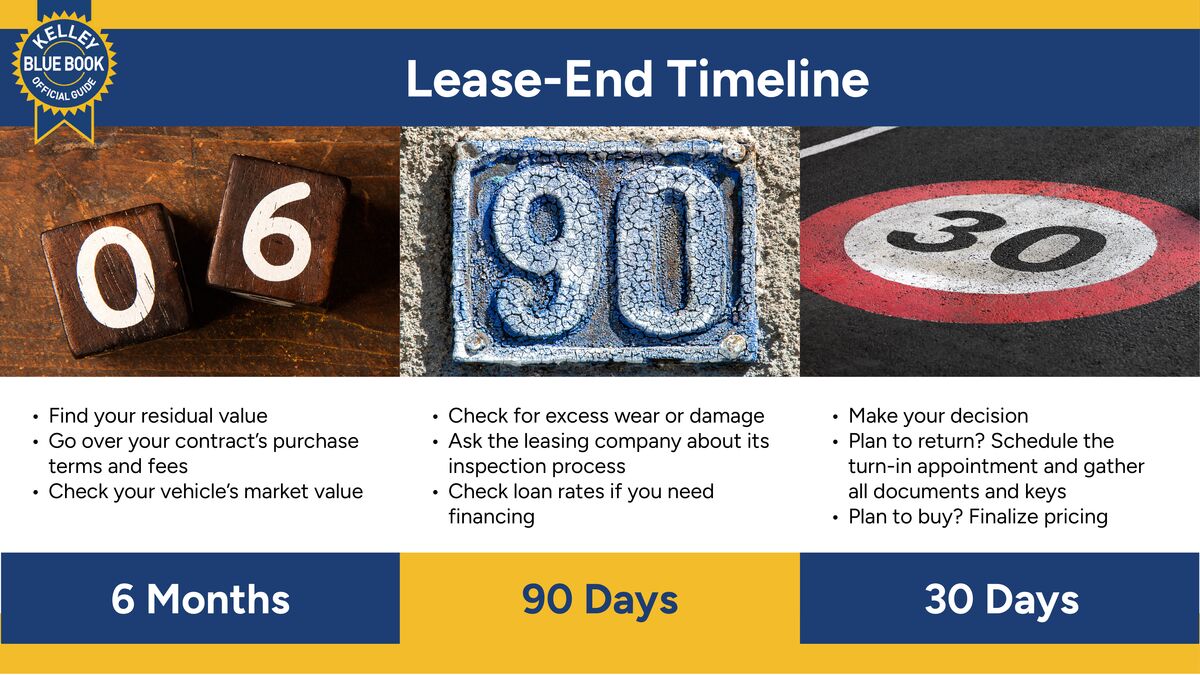
Don’t wait until the final week of your lease to decide what to do.
About Six Months Before Lease End
Find your residual value in the contract and contact your leasing company to learn the purchase terms and fees. Check your vehicle’s approximate market value.
Also review your mileage. If you are approaching your allowance, knowing that early can help you manage how much you drive before turn-in.
About 90 Days Before Lease End
Check the vehicle for excess wear and damage. Ask the leasing company about its inspection process and whether you can schedule a prereturn inspection.
If you are considering buying the vehicle and will need financing, start checking loan rates.
About 30 to 45 Days Before Lease End
Make your decision.
If you plan to return the car, schedule the turn-in appointment and determine what documents, keys, equipment, and accessories you need to bring.
If you plan to buy it, get an updated payoff quote and finalize financing.
On Turn-In Day
Bring everything required by the leasing company, including all keys and any equipment that came with the vehicle.
Document the vehicle’s condition and mileage, and keep copies of paperwork showing that you returned it.
After a Buyout
If you are purchasing the vehicle to sell or trade it, find out how long the title process will take. You generally cannot complete an ordinary private-party sale until you have the documentation necessary to transfer ownership.
MORE: Lease Car Return Tips: Plan Ahead to Reduce Out-of-Pocket Expenses
Frequently Asked Questions
Compare the total payoff amount with the vehicle’s current market value. A buyout can make sense if you like the car and the payoff is competitive with what similar used vehicles cost. If the payoff substantially exceeds market value, returning the car may be the less expensive option.
The residual value was estimated when the lease began. Used-car values can rise or fall during the lease, so the vehicle’s actual market value at lease end may differ substantially from that earlier estimate.
Start with the leasing company. Ask for the official payoff amount and an itemized list of required fees. If you work through a dealer afterward, you can compare the dealer’s quote with the lessor’s number and identify any additional charges.
Potential costs include a purchase-option fee, sales tax, registration and title fees, remaining payments, and other charges specified in the lease. Ask the leasing company for an itemized payoff quote before deciding.
Depending on your leasing company’s rules, you may be able to buy the vehicle and then trade or sell it. Some lessors allow third-party buyouts, while others require you to purchase the vehicle first.
Possibly, but it depends on the leasing company. Some lessors allow a dealer or online car buyer to purchase the vehicle directly, while others restrict third-party buyouts. If your lessor does not allow one, you may need to buy the car and take title before selling or trading it.
The residual value established in your lease contract generally does not change. However, the leasing company may offer or agree to a lower buyout price, or an automaker may provide a lease-end purchase incentive.
The leasing company will evaluate the vehicle for mileage, condition, and other lease requirements. You may owe charges for excess mileage, excess wear and tear, or a disposition fee depending on your contract.
The Bottom Line
Don’t decide what to do with your leased car until you know what it costs to buy and what it is worth today.
If the vehicle is worth more than the payoff, investigate whether you can capture that equity. If it is worth less, returning it may be the better financial choice, although a discounted buyout could change the calculation.
Get the payoff directly from your leasing company, understand every fee, and compare the total cost with current Kelley Blue Book values before making your decision.
Editor’s Note: We have updated this article since its initial publication.