

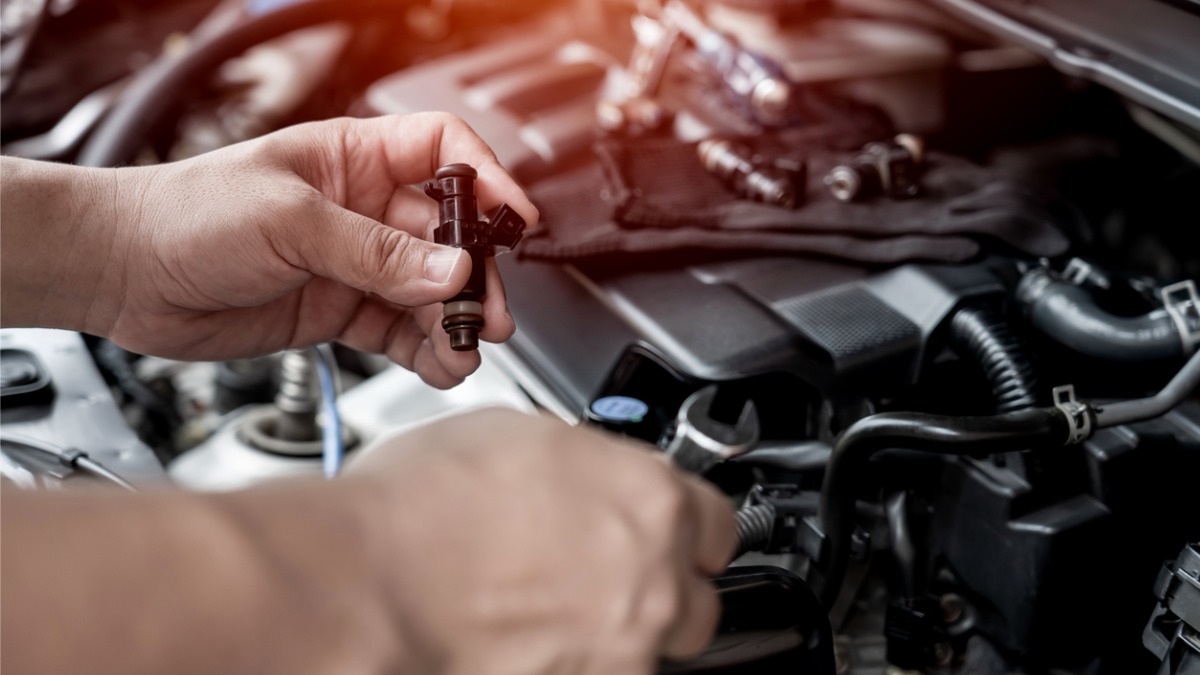
Is shelling out the money for fuel injection cleaning, which is sometimes suggested by garages and repair shops, a worthy investment in your vehicle? The odds are, your vehicle doesn’t need a fuel injector flush. If the car is performing normally and your “check engine” warning light isn’t illuminated, don’t fret over flushing the fuel injectors.
- Do Fuel Injectors Need To Be Flushed?
- What Are Fuel Injectors?
- Do You Need a Fuel Injector Flush?
- How To Avoid Dirty Fuel Injectors
Do Fuel Injectors Need To Be Flushed?
Fuel injection service is part of a larger family of automotive maintenance procedures, including flushes for crankcases, power steering pumps, cooling systems, differentials, and other lubricated parts.
Carmakers have greatly improved fuel injection systems, and most high-quality gasoline is formulated with additives that help keep fuel injectors operating at full efficiency. Don’t allow an unscrupulous mechanic to talk you into an expensive flush that your car doesn’t need.

If the injectors ever do require flushing, your car will let you know.
What Are Fuel Injectors?
Fuel injectors are part of the modern delivery system to get gasoline from a car’s tank into an engine’s combustion chamber. Once upon a time, a carburetor mixed fuel with air, which it then fed into the cylinder’s combustion chamber. A spark from the cylinder’s spark plug ignited the fuel-air mixture, driving that cylinder’s piston downward. A crankshaft connects the pistons, which, when fired in a series, spin the crankshaft, creating the energy that eventually works its way to the drive wheels.
Fuel injection has replaced the carburetor in passenger vehicles made over the past several decades. In simple terms, a fuel injector is an electronically-controlled valve. It functions to pressurize gasoline from the fuel pump and air from the intake into a fine mist as it enters the cylinder’s combustion chamber. One or more clogged injectors will reduce the engine’s efficiency and performance, potentially even causing it to stall.
Do You Need a Fuel Injector Flush?
Dirty fuel injectors can reveal themselves through various symptoms. Although some of the symptoms we list can be caused by various failures or malfunctions, dirty fuel injectors are certainly among them.
| DID YOU KNOW? Fuel injection cleaning makes less sense today than it did 30 or more years ago when injection systems fully replaced carburetors. At that time, poorly formulated gasoline and badly designed injector nozzles caused many fouled and plugged injector tips. But that’s far less the case today. |
Here are some symptoms of dirty fuel injectors to be on the lookout for:
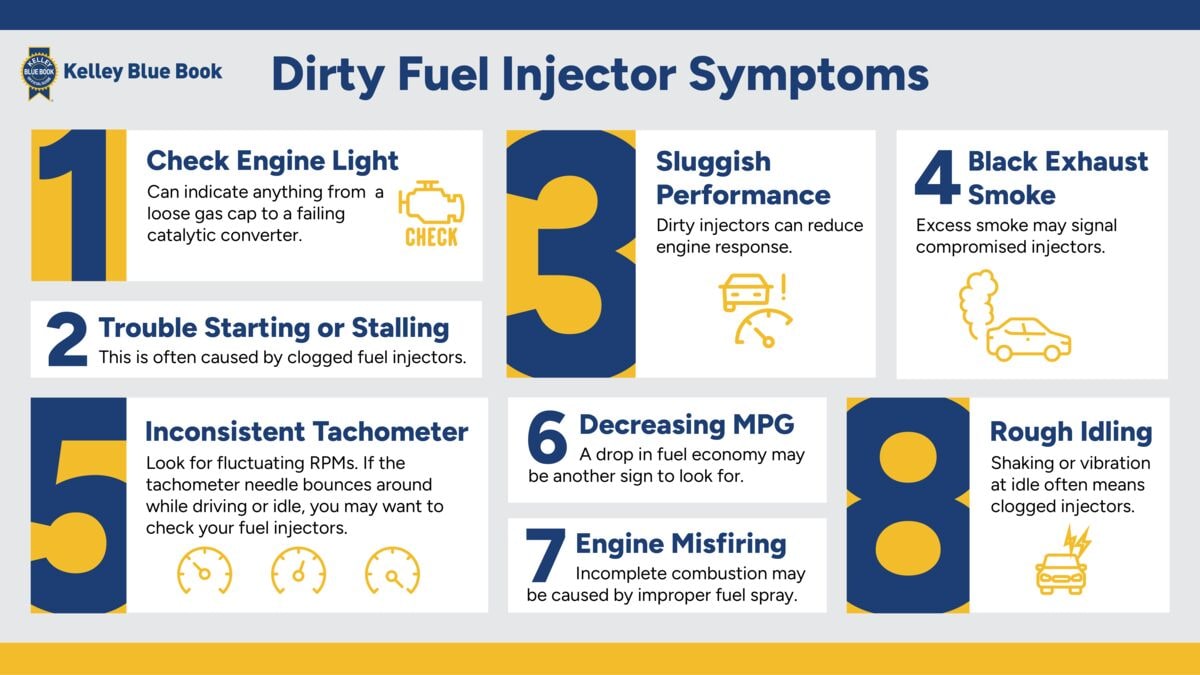
- “Check Engine” warning light illuminates: Any number of issues can cause the check engine light located within the gauge cluster to pop on. Something as innocuous as a loose fuel filler cap to more important issues, such as a failing catalytic converter, can trigger the check engine light. Only a trained professional or, if you are more of a do-it-yourselfer, using an OBD-II scanner to diagnose the problem yourself will expose the exact cause.
- Trouble starting or stalling: If your engine is slow to start or does start and then stalls, the cause may be clogged fuel injectors.
- Sluggish performance: A lack of engine response when goosing the accelerator pedal or if your car’s engine seems to struggle going uphill, the culprit could be dirty fuel injectors.
- Black exhaust smoke: An extreme amount of black exhaust smoke can be traced back to compromised fuel injectors.
- Fluctuating tachometer: If your car’s engine isn’t getting the ideal fuel-air mix, it may react with radically fluctuating RPMs. In other words, if your tachometer needle begins bouncing around when the car is idling, you could have a fuel injector issue.
- Decreasing mpg: A noticeable drop in your car’s fuel economy may be another sign that the fuel injectors are malfunctioning.
- Engine misfiring: Incomplete combustion or misfiring is often caused by fuel injectors not spraying the fuel-air mixture appropriately.
- Rough idling: If your car vibrates or shakes when idling, its fuel injectors could be clogged.
NOTE: If you need your fuel injector flushed, find a mechanic at a repair shop near you. You can also find maintenance schedules for your vehicle with repair pricing in your area.
How To Avoid Dirty Fuel Injectors
You can help ensure your fuel injectors remain healthy and operate at peak capacity by doing two things.
- Avoid cheap gas: Putting off-brand gas in your vehicle may save a few pennies at the pump, but it could cost you big bucks in the long run. Quality fuel will more likely have the additives formulated to help keep your car’s fuel injectors gunk-free and performing up to par.
- Change the fuel filter: A dirty fuel filter can allow contaminants to enter your engine. Each injector has a tiny filter of its own, which can become clogged if the fuel filter fails to trap all potential contaminants. Get pricing on changing your fuel filter.
Unless you are experiencing one or more of the dirty fuel injector symptoms listed above, don’t be too concerned about flushing the injectors. Buying quality gas and keeping up with routine maintenance should keep the fuel injectors performing at peak efficiency for miles to come, and in turn, help retain your car’s value over time.
RELATED: Car Maintenance Guide: Everything You Need To Know
Editor’s Note: We have updated this article since its initial publication. Russ Heaps contributed to the report.