


There are several reasons you might need a new or updated car title: It’s lost, damaged, stolen, or you’ve changed your name. Whatever the cause, if you don’t have a title, it’s smart to replace it before you actually need it so you’re not scrambling at the last minute.
You’ll likely need a valid title to sell, trade, dispose of, or re-register your car after moving to another state — and it might take two to six weeks for the replacement to arrive. Keep reading for an overview of how to get a replacement title and what documentation you’ll need.
What Is a Car Title?
A car title is proof of ownership. It’s a legal document issued by a state that identifies a specific car and its owner. When a vehicle changes hands, the owner’s identity changes, but the car’s identity remains the same. The title includes the vehicle identification number (VIN), year, make, model, and color.
You’ll only have the original title if you own the vehicle outright.
- If you finance a car, you usually won’t get the original until it’s paid off. If you do have a title while you’re making payments, it’s a copy showing the finance company as the lienholder.
- If you lease, you don’t own the car unless you buy it at the end of the lease. Leasing is similar to a long-term rental, where the lessor retains ownership and holds the title to the property.
MORE: How To Sell a Car Without a Title
What Do You Need to Replace a Car Title?
Each state has its own process and requirements. Your DMV can tell you exactly what paperwork you need. Generally, you can expect to provide:
- The 17-digit VIN: Located on the driver’s side dashboard and the door jamb.
- Year, make, and model: For example, a 2019 Chevrolet Malibu.
- License plate: Plate number and state.
- Odometer reading: The total miles shown on the gauge panel.
- Proof of ownership: For example, a notarized bill of sale or registration.
- Lienholder information: If applicable, include contact details and, if necessary, a signed release form.
- Driver’s license: A government-issued ID. Some states may also require a recent utility bill to confirm your address.
- Fees: A replacement fee is required. Check the amount and accepted payment methods.
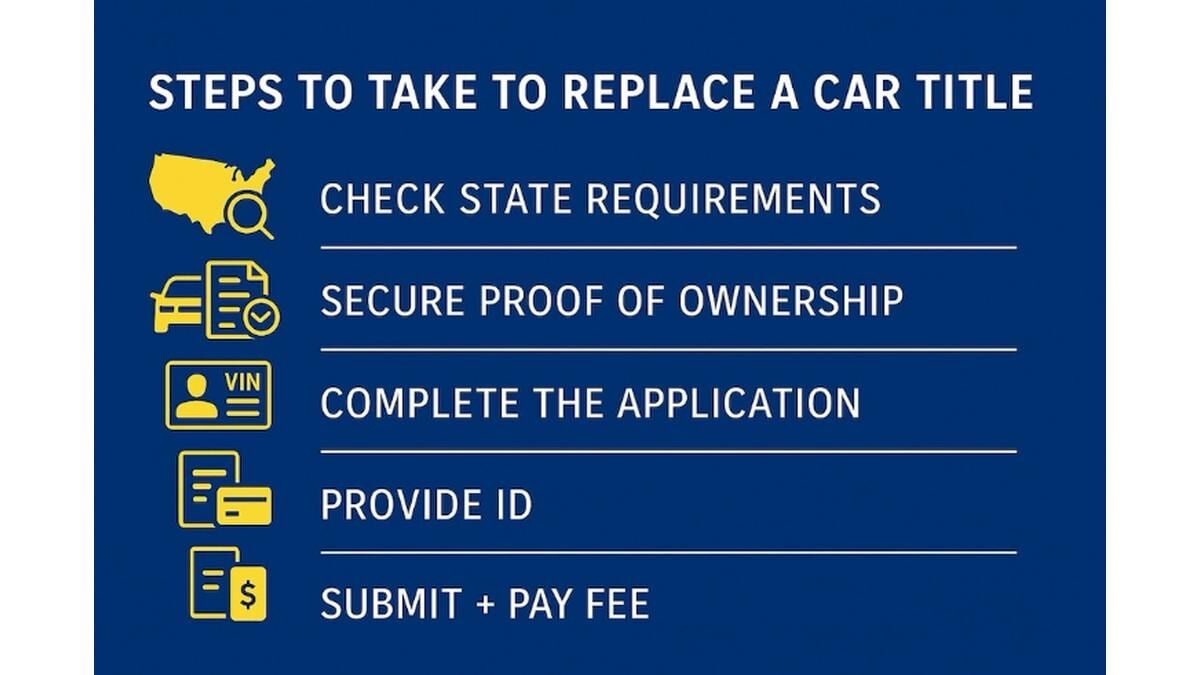
Steps to Take to Replace a Car Title
Determining your state’s requirements for title replacement is the first step in the process. Once you understand the rules, you can gather the required documentation and complete the necessary forms.
State Requirements
Each state sets its own rules, and requirements vary, so be sure to check with your DMV or equivalent agency. Many states allow online applications, while others don’t. Some states may require a new title when the owner changes their name. Here are a few examples that outline the process for replacing a clean title.
New York
You can apply online, by mail, or in person.
- Online: Fastest option. You must meet certain criteria (for example, no lien, no recent title changes). Fee: $20.
- By mail: Submit Form MV-902, a copy of your NY ID, and a check/money order for $20 to the DMV Title Bureau in Albany.
- In person: Bring the same documents to a DMV office. Titles are printed in Albany and mailed, not handed out on-site.
California
Apply by mail or in person at a DMV office. Titles typically arrive in 15–30 days.
- Complete Form REG 227 with the VIN, license plate number, and ownership details.
- Fee: $23–$27, depending on vehicle type.
- If there’s a lien, you may need a notarized lien release (Form REG 166).
- By mail: Submit to DMV Vehicle Registration Operations, Sacramento, CA.
- In person: Bring your original ID and completed form. Notarization may be required in some situations.
Texas
Apply by mail or in person at select TxDMV Regional Service Centers.
- Use Form VTR-34.
- Fee: $2 by mail, $5.45 in person.
- All owners must sign and provide photo ID.
- If a lien exists, include an original lien release.
- By mail: Mail your application to: TxDMV, 1601 Southwest Parkway, Suite A, Wichita Falls, TX.
- In Person: Replacement titles are available at 16 Regional Service Centers (for example, Dallas, Austin, San Antonio). Wichita Falls is the only location that accepts mail-in applications.
Can You Get a Replacement Title Online?
In a world where almost everything can be done online, it’s easy to assume the same is true for replacing a car title. In reality, it depends on the state. Of our three examples above, only New York accepts applications for replacement titles online. Even then, New York limits online applications to residents who are already listed as the owner on the title they’re replacing.
Check with your state’s DMV to see which options are available.
What Are Electronic Titles?
Electronic lien and title programs allow lenders and DMVs to exchange title information electronically. Sometimes called electronic titles, e-titles, or digital titles, these files serve as legal documents of ownership. Consumers don’t see the benefits directly.
Dealers, lenders, and DMVs use electronic titles to streamline processes, improve efficiency, and reduce costs associated with paper titles. Once you pay the loan in full, the lender releases the lien electronically. In most states, the DMV then prints and mails a lien-free paper title to the owner or keeps a lien-free electronic title on file.
Today, roughly 30 states have electronic titling. About half are mandatory for most institutional lienholders, and the rest offer ELT on an opt-in basis.
What if the Car Isn’t in Your Name?
The process for getting a replacement title when you aren’t the owner varies depending on the situation and your location. Contact your state DMV for guidance for your specific circumstances.
Here are two common scenarios when replacing a title that isn’t in your name might be necessary.
Death and Inheritance: When a relative dies, the car remains part of their estate. The estate’s executor will settle the estate’s financial obligations and distribute the remaining assets, typically under the supervision of the probate court. The person inheriting the car can usually apply for a new title using the old title, the death certificate, and proof of asset release. If the old title is missing, provide proof that you’re the beneficiary, including the death certificate and vehicle year, make, model, color, odometer reading, and VIN. States may require additional documents and a fee, but the process is generally straightforward.
Lost Transfer Title: When a transferred title is lost before filing, contact the former owner and ask them to apply for a replacement and sign it over to you. Offer to cover any fees. If the owner is unavailable or uncooperative, you may be able to apply for a bonded title. Buying a surety bond for the car’s estimated value will be required to protect against ownership disputes. The bond cost is a percentage of the value. After a set period (often about three years), you can request a clean title. The bonding company keeps the bond payment.
Quick Fix: Answers to Car Title Replacement Questions
Q: How do I replace a stolen car title?
A: Every state’s process is different, so start by contacting your state’s DMV. You will need to complete a title replacement form, provide vehicle details and an approved photo ID, and pay the required fee.
Q: Can I get a replacement title the same day?
A: In some states, yes, if you apply in person and pay an expedited fee (for example, South Carolina charges $20).
Q: How long does getting a replacement title take?
A: Most states mail the replacement title within two to six weeks, though some offer expedited or same-day services for an extra fee.
Editor’s Note: This article has been updated since its initial publication. Russ Heaps contributed to the report.