

Key Reminders About Vehicle Safety Features:
- Virtually any driver assistance technology also qualifies as safety technology. For example, rear cross-traffic alert is standard or available on nearly every new car, truck, and SUV. It warns the driver when another vehicle is approaching from the side while the driver is reversing. Not only does this feature make the driver’s job easier, but it also makes the occupants both vehicles safer. It’s both a driver aid and a safety feature.
- Some safety features will rely on driver input and some do not. Car safety features can be passive, such as seat belts and airbags, or active, such as stability control and automatic emergency braking.
- Safety technology is always evolving. Because of the steady introduction of AI features, new technologies, and the relentless evolution of current ones, a 100% comprehensive list of safety features is a unicorn you probably won’t be able to find. This guide will give you a solid foundation.
- Some optional safety features will eventually be federally mandated. Some advanced safety features might feel like bells and whistles, but you can expect many of them to become mandatory at some point. For example, regulations are already in place making automatic emergency braking required equipment on all passenger vehicles by the 2029 model year.
A car safety feature is any feature that helps minimize the risk of an accident or reduce the effects of a collision on the vehicle’s occupants. It encompasses everything from crumple zones to antilock brakes to adaptive cruise control with full braking. A recent report from the National Highway Traffic Safety Administration (NHTSA) and a coalition of carmakers concludes that advanced safety features, such as forward collision alert and automatic emergency braking, reduce the risk of a serious crash by 49% while lowering the risk of injury by 53%.
Our car safety features guide walks you through modern automotive safety tech. If you’re looking to buy a new or used car, safety may be top of mind. Fun fact: For many decades, automakers fiercely resisted prominently marketing safety features to the public. For example, seat belts came into being in the 1930s but didn’t move to the forefront of safety design until the early 1960s. Carmakers refused to include them for years, fearing the negative safety message that installing seat belts would send. Today, however, car companies are just as likely to advertise their safety features as they do fuel economy, technology, or performance.
If you’re in the market for a vehicle, or just want to learn more about what’s available, browse our features groupings below, which will walk you through the many aspects and applications of modern car safety features.
- Passive and Structural Protection Features
- Foundation Active Safety and Vehicle Control Features
- Collision Warning and Automatic Avoidance Features
- Lane, Speed, and Road Management Features
- Visibility, Awareness, and External Alerts
- Driver, Occupant, and Convenience Safety Features
Passive and Structural Protection Features
For the most part, the government mandates standard safety features. It’s a long list of devices and attributes, many of which are commonly known. That’s because the government creates safety standards for everything from a car’s structural framework to its tires. The government’s best-known auto safety arm is the National Highway Traffic Safety Administration, or NHTSA. The not-for-profit Insurance Institute for Highway Safety (IIHS) is the other best-known North American arbiter of car safety. These are the most common passive and structural features that help protect drivers and passengers without requiring driver input.
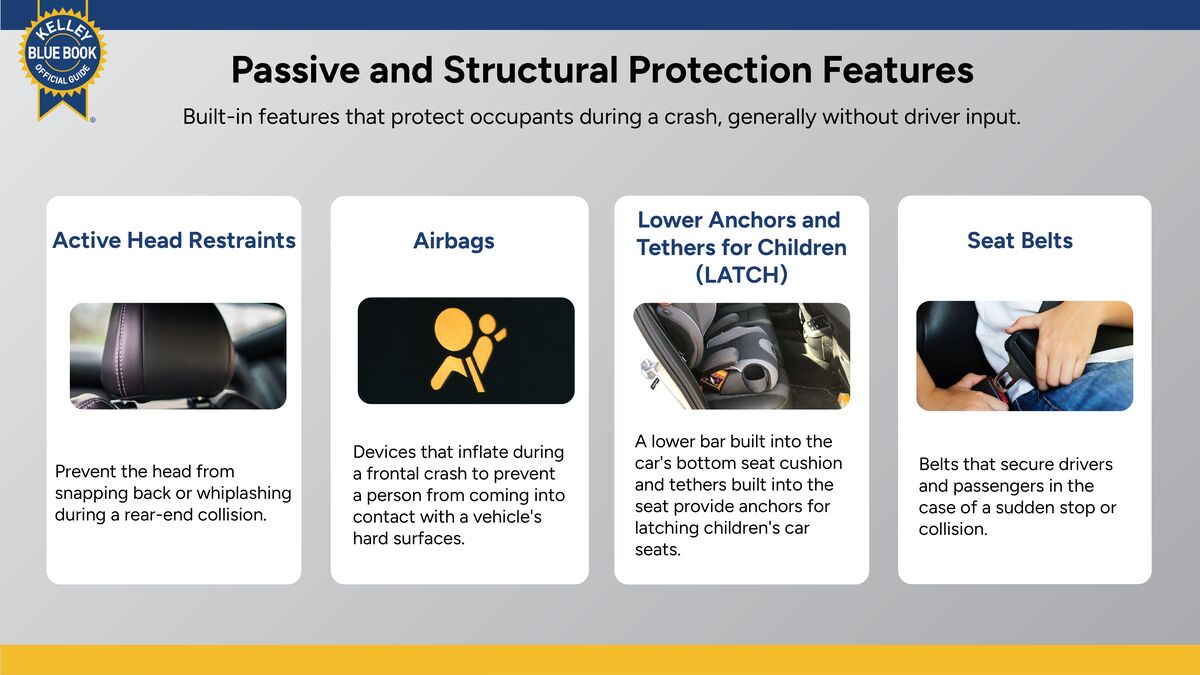
Active Head Restraints
Although front-seat head restraints have been mandatory in passenger cars since 1969, active head restraints are not. Not every head restraint is an active head restraint. Saab pioneered the widespread use of active head restraints in 1998, with Volvo close behind.
Different methods can achieve the action of an active head restraint, but essentially, it moves the head restraint up and forward during a rear-end collision. The action helps prevent the head from snapping back, reducing the risk of whiplash.
Airbags
Mandatory in 1999 for all passenger cars, light trucks, and vans (front seat).
Today, most new cars and SUVs offer at least six airbags. Some boast a lot more. For instance, the Toyota Camry comes with 10 airbags.
The federal mandate for airbags only extends to the front seats. However, carmakers continue developing additional airbags. Some cars have front knee airbags, center airbags that deploy between occupants in the same row, and even panoramic-roof airbags.
They aren’t perfect, but airbags do much more good than harm. The IIHS found that front airbags reduce driver fatalities in frontal crashes by 29% and reduce fatalities among front-seat passengers aged 13 and older by 32%.
Airbags inflate during a frontal crash to prevent a person from coming into contact with a vehicle’s hard surfaces. Sensors at the front of a vehicle measure and respond to frontal collisions.

If the crash force is sufficient to warrant airbag deployment, the sensors transmit a signal to the igniter in the airbag inflator. This signal triggers a chemical reaction, producing a gas, usually a mixture of helium and argon, that rapidly inflates the airbag.
The inflation of an airbag works like a controlled explosion; the gas fills the bag in less than one-twentieth of a second at a force of up to 200 mph. Such force can even affect a healthy adult, let alone a child or an older adult. Consequently, government safety experts say a person needs to create at least 10 inches of space between themself and a frontal airbag. So, for safety reasons, the back seat is the best place for younger children.
However, many newer vehicles now offer technology to detect the presence of occupants and measure their weight and position in the seat. Such systems can then reduce the force of airbag deployment to minimize injury.
Side-curtain airbags protect the head and neck during rollovers and side impacts, while torso-protecting side-impact airbags round out the six airbags found in most new cars.
Lower Anchors and Tethers for Children (LATCH)
Mandatory in 2002 for all passenger cars.
Mandating LATCH compatibility in cars was a giant leap forward in automobile child safety. As a result, LATCH is the standard by which all child safety seats are installed.
A lower bar built into the car’s bottom seat cushion provides an anchor for clips on the bottom of the safety seat. Tethers located at the top of the safety seat then clip onto tether anchors built into the car’s seatback or some other location.
Not only does LATCH create a more secure platform for child safety seats, but its user-friendly installation also encourages their more widespread use. However, in most vehicles, not every rear seating position has a full latch setup, with fewer than 20 vehicles offering 3-across seating in the same row.
Seat Belts
Mandatory in 1968 for all passenger cars.
Mandating seat belts in cars required decades of effort and even a United States Supreme Court ruling. But today, we have seat belts in every seating position of every passenger vehicle. Many tout the three-point seat belt as the single most effective safety measure ever. NHTSA claims wearing a seat belt in the front seat of a car or truck cuts your risk of a fatal injury nearly in half.
Incredibly, only one in 10 drivers wore a seat belt as recently as 2004, saying they were cumbersome and uncomfortable. Not so today. We can credit seat belt pretensioners for making safety belts more comfortable. These gadgets allow the seat belt to give us space as we naturally move but instantly cinch tight in a frontal impact. Adjustable anchors on the vehicle’s B-pillar, often located at the front seat positions, allow the height to be adjusted. These are a real benefit for shorter drivers, who used to deal with the shoulder belt cutting across their neck. Although most newer cars provide a safety-belt warning that alerts front-seat occupants of unbuckled seat belts, the government mandate for such alerts applies only to the driver’s seat.
Beginning in 2026, all seating positions must have safety-belt alerts.
With the expectation of saving 50 lives per year and preventing countless injuries, NHTSA has finalized a regulation mandating safety-belt warning alerts beyond just the driver’s seat, extending them to all seating positions in 2026.
Foundation Active Safety and Vehicle Control Features
Modern mainstream vehicles come equipped with different baseline systems that help the car maneuver safely. These features affect how a vehicle stops, stabilizes, and maintains traction, as well as alerting drivers to important maintenance needs, such as tire pressure issues.
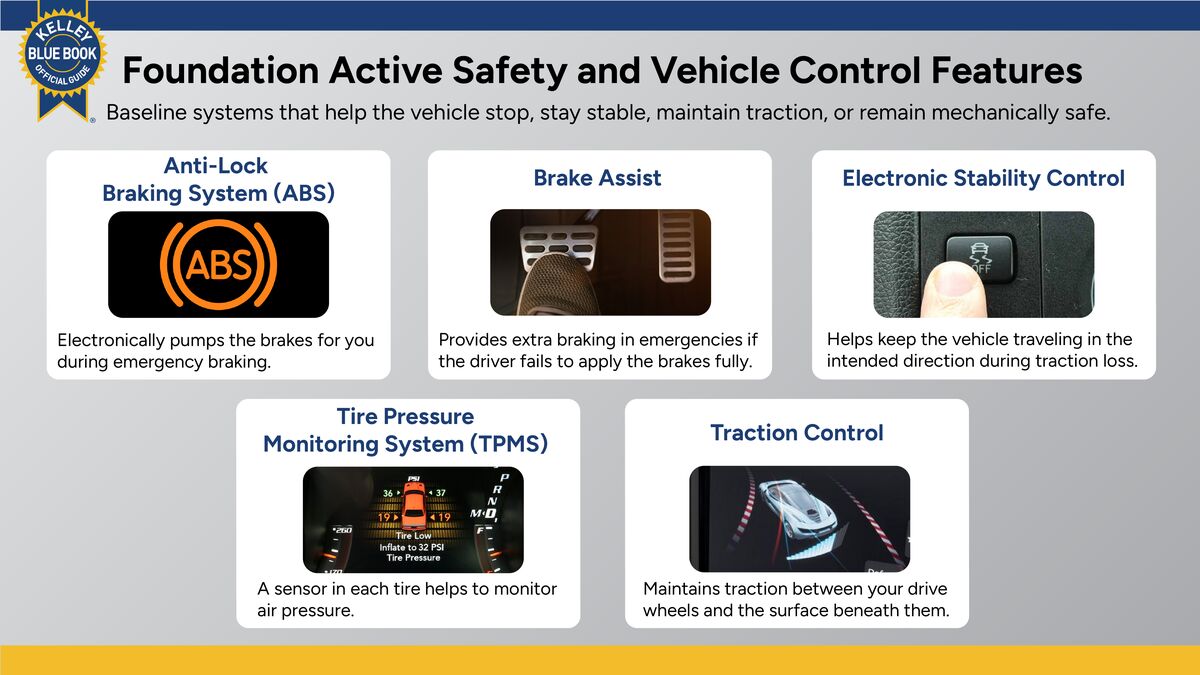
Anti-Lock Braking Systems (ABS)
Mandatory in 2000 for all new passenger cars.
Sensors placed in each wheel act as monitors that report speed, grip, and other performance factors. They constantly send updates to your car’s computer. Each sensor also communicates with and controls the brake device on each wheel. This is the foundation for your car’s antilock braking system (ABS).
There is a misconception that ABS increases braking force, leading some to believe it helps a vehicle stop more quickly. Although somewhat shorter stops are a byproduct of ABS, it’s engineered to help a driver maintain steering control during emergency braking.
When braking for an emergency, such as a pedestrian stepping in front of you or the vehicle ahead coming to an abrupt, unexpected stop, our knee-jerk reaction is to push the brake pedal to the floor. When this happens without ABS, the brakes lock up, your wheels stop rotating, and you begin to slide.
Newton’s first law of motion is that an object in motion tends to stay in motion. That is, even with its brakes fully locked, your vehicle will continue in the direction it was moving. Depending on the vehicle’s weight and speed, it might continue to slide forward for 100 feet or more.
Moreover, your steering control is zero when your brakes are locked, and the wheels are no longer rotating. Turning the steering wheel in one direction or the other will not alter the direction of the slide. In this instance, your only hope is that the slide will peter out before you strike the object you are trying to avoid.
Advanced driving schools once taught the technique of rapidly pumping the brakes during an emergency stop. This would still eventually stop the vehicle, but the pumping motion also allowed some wheel rotation, providing enough steering control to avoid the object you were trying to avoid.
Antilock brakes electronically pump the brakes for you during emergency braking. With the brake pedal depressed to the floor, you can feel the shudder of the ABS working through the brake pedal.
The pumping motion of antilock brakes will help you stop somewhat more quickly. However, the most significant benefit is retaining steering control. Here’s the best part: Your vehicle’s computer can pump the brakes more quickly and effectively than you can. Therefore, on cars with antilock brakes, push the brake pedal with all your might and concentrate on steering yourself out of trouble.
Antilock brakes are a crucial component of traction control and electronic stability control, detailed below.
Brake Assist
Brake assist was around before the push for semi-autonomous cars. Nonetheless, it’s still a valuable safety feature.
Drivers are human, so their reactions to emergencies vary. Brake assist is engineered to provide extra braking in emergencies when the driver fails to apply the brakes fully. In such instances, the brake-assist system initiates emergency braking and maintains it until the driver releases the brake pedal.
Some brake-assist systems measure the time it takes a driver to switch from the accelerator to the brake to determine whether to engage. Radar or camera-based systems anticipate emergency braking situations, initiating braking a split second before the driver’s foot reaches the brake pedal.
Sadly, the human factor again comes into play if the driver panics and releases the brake pedal prematurely.
Electronic Stability Control
Mandatory in 2012 on all passenger cars.
Also utilizing the ABS sensors and independent four-wheel braking, electronic stability control’s task is to keep the vehicle traveling in the direction you are steering. More complex than either ABS or traction control, stability control relies on both to help achieve its mission.
Your stability control system employs more sensors than those borrowed from the ABS. These extra sensors measure yaw (sideways motion) and steering angle. The stability control system is functional as long as the vehicle follows your steering inputs, such as turning right when you turn right, and turning left when you turn left.
Suppose the vehicle isn’t heading in the direction the front wheels are pointed. The stability control system can use every tool ABS and traction control offer to return the car to its intended course. This may involve applying the brakes to specific wheels and even reducing or modulating engine speed.
This system isn’t foolproof. It can’t overcome physics. You know, that whole law of motion thing. However, it can help keep your vehicle on the straight and narrow under normal conditions.
Tire Pressure Monitoring System (TPMS)
Mandatory in 2007 for all passenger cars, light trucks, and vans.
Using a sensor inside each tire to monitor air pressure, TPMS warns you when a tire is low on pressure. Some systems constantly display the current pressure in each tire as a function of the driver information display.
Traction Control
Mandatory in 2011 on all passenger cars.
Traction control is just what it sounds like: a system that helps maintain traction between your drive wheels and the surface beneath them. It is particularly helpful in slippery conditions.
Think of traction control not as increasing traction, but as regulating it to prevent the drive wheels from spinning at different rates. Using ABS sensors on each wheel, the traction-control computer reduces power (torque) to a particular drive wheel if it’s spinning faster than the others. In modern systems, applying braking pressure to the spinning wheel reduces torque.
Such wheel spin typically occurs on slippery surfaces, particularly in corners or when accelerating. At times, you will feel a little kick to the right or left as the system self-corrects.
Collision Warning and Automatic Avoidance Features
Cutting-edge technologies thrive in collision avoidance. Everyone wants to be safe and avoid accidents. Many of the driver aids listed here result from the race to develop fully self-driving vehicles. While we may still be decades away from cars without steering wheels and pedals zipping around on accident-free streets, we continue to reap the rewards of ever-changing safety technology as carmakers work toward that goal.
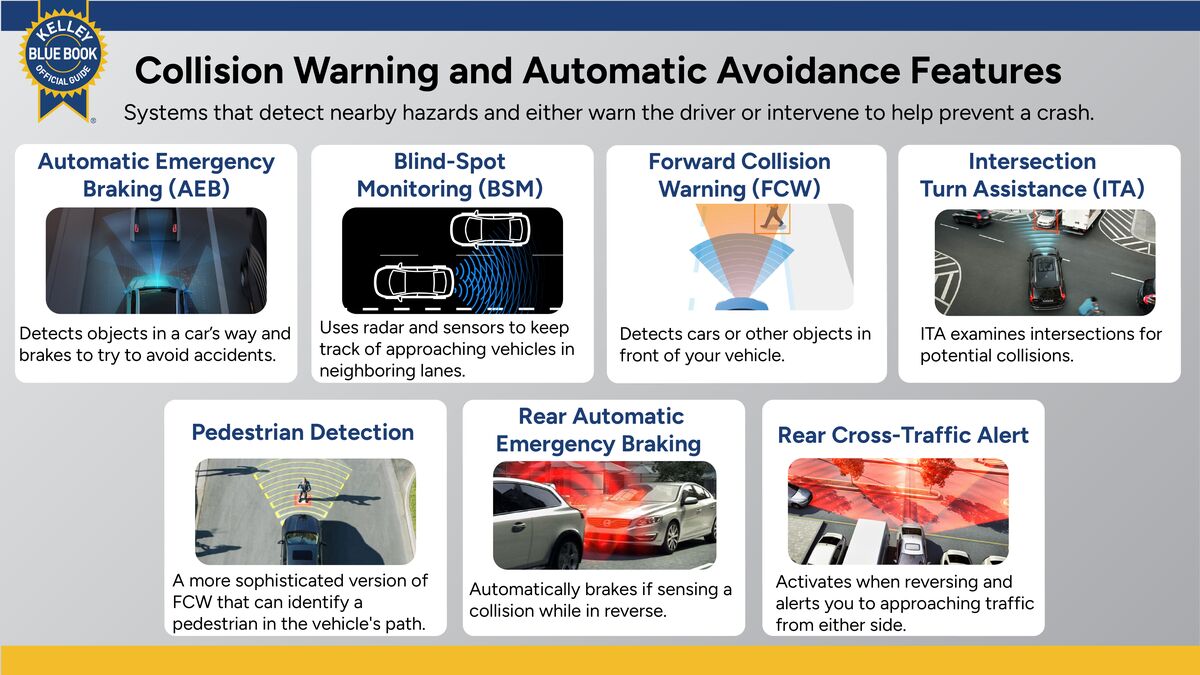
Automatic Emergency Braking (AEB)
Will be mandatory in 2029 on all passenger cars, light trucks, and vans.
Automatic emergency braking (AEB) systems detect an object in a car’s path and brake to try to avoid an accident. Earlier versions of the technology helped drivers avoid hitting a stopped car. Newer versions are designed to detect smaller objects. Though most new cars already offer automatic emergency braking, the federal government mandates that this safety feature in every new vehicle by 2029. NHTSA, the government agency most responsible for regulating cars, estimates that automatic emergency braking systems “will save at least 360 lives a year and prevent at least 24,000 injuries annually.”
However great the technology, it often doesn’t live up to its marketing. It works best at low speeds, and an insurance industry lab recently found in testing that systems can disappoint when drivers go above 25 mph. Other tests found the systems work less effectively at night. The new mandate will require these systems to work more effectively to help keep drivers safe.
“The new standard requires all cars to be able to stop and avoid contact with a vehicle in front of them up to 62 mph,” NHTSA says. Cars must also “detect pedestrians in both daylight and darkness. In addition, the standard requires that the system apply the brakes automatically up to 90 mph when a collision with a lead vehicle is imminent and up to 45 mph when a pedestrian is detected.”
Blind-Spot Monitoring (BSM)
BSM takes some of the adventure and danger out of changing lanes.
To track approaching vehicles in neighboring lanes, a basic BSM system relies on radar or ultrasonic sensors, typically located on both sides of the rear bumper. Some more advanced systems pair the sensors with side-mounted cameras.
BSM alerts you to vehicles entering your vehicle’s rear-quarter blind spots. These alerts can take the form of warning lights on your vehicle’s A-pillars, outboard mirrors, or, if your car is so equipped, the head-up display. The warning may also be tactile if your car has a haptic steering wheel or driver’s seat.
Forward Collision Warning (FCW)
We are reasonably sure forward collision warning will be one of the current advanced safety technologies mandated by the government. Having already found its way into several mainstream vehicles as standard equipment, it is gaining ground as a must-have driver-assist/safety technology. Moreover, its popular companion technology, automatic emergency braking, is mandated for the 2029 model year.
Employing cameras, radar, lasers, or some combination of the three, FCW detects cars or other objects in front of your vehicle. More sophisticated FCW systems can also detect pedestrians, cyclists, and even animals.
As an FCW-equipped vehicle approaches a detected object and senses a potential collision, the system issues a warning. That warning may be visual, audible, tactile, or some combination of the three.
Many of the newer FCW systems also include automatic emergency braking, see below.
Intersection Turn Assistance (ITA)
This system, which combines FCW and automatic emergency braking, examines intersections for potential collisions. For example, it can detect vehicles, pedestrians, or cyclists crossing your path. It will also alert you to the approach of a vehicle in the opposite direction as you initiate a left-hand turn. It provides both warnings and automatic braking if the driver doesn’t react.
Pedestrian Detection
A more sensitive version of forward collision warning or rear cross traffic warning, pedestrian detection can identify a pedestrian in the vehicle’s path. Because pedestrian detection is more sophisticated than FCW, it usually, but not always, includes automatic emergency braking. Many of today’s FCW systems can also detect cyclists and, in some cases, even animals.
Rear Automatic Emergency Braking (RAEB)
This feature automatically brakes when it senses a collision while the vehicle is in reverse. RAEB may also have a pedestrian-detection function.
Rear Cross-Traffic Alert (RCTW)
More often than not, RCTW is paired with blind-spot monitoring because both rely on radar or ultrasonic sensors embedded on each side of the rear bumper. Sometimes RCTW involves the rearview camera, as well.
RCTW activates when you are reversing out of a parking spot, driveway, or otherwise backing into the path of crossing traffic. It alerts you to vehicles approaching from either side on that path. The warning can be audible, visual, or tactile.
Some RCTW systems include automatic full braking, preventing you from backing into trouble.
Lane, Speed, and Road Management Features
While drivers need to be alert and aware of what’s happening around them on the road at all times, several technologies and safety features provide added assistance with driving instances such as managing following distance, responding to road information, and helping the vehicle stay positioned properly.
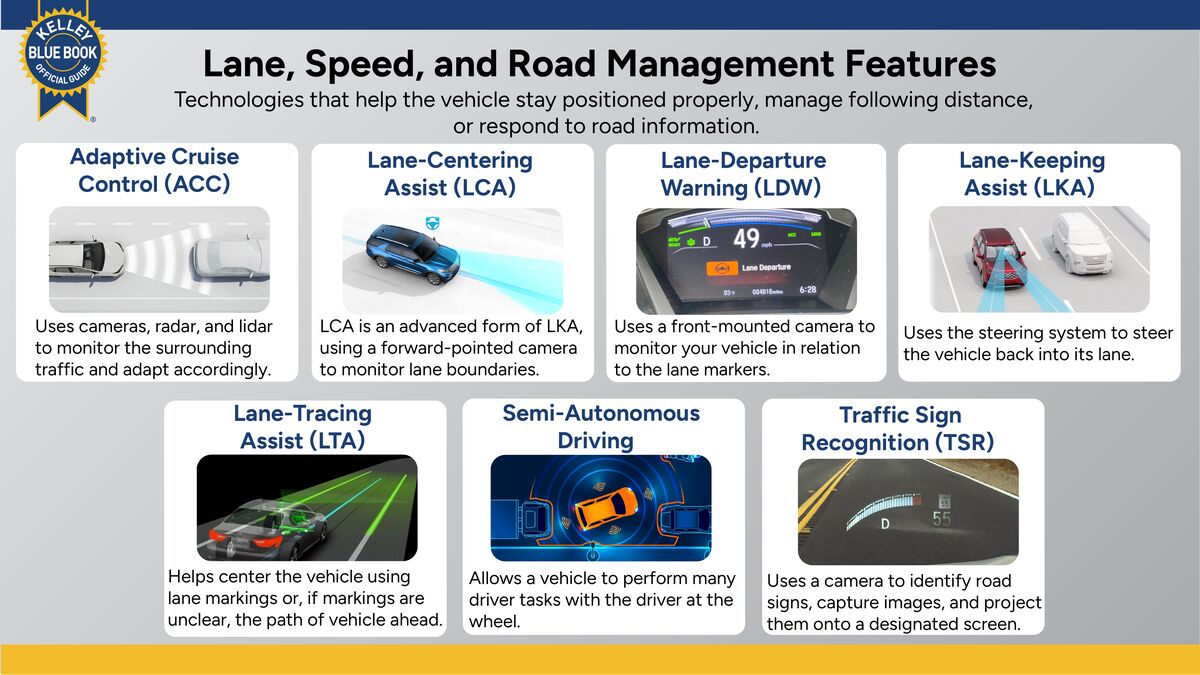
Adaptive Cruise Control (ACC)
Adaptive cruise control is to regular cruise control what your smartphone is to two tin cans and a string.
Standard cruise control is designed to maintain a preset speed, regardless of the behavior of surrounding traffic. The driver can apply the brake to disengage it or push the “Resume” button to re-engage it. Adjusting the speed setting to reflect changing speed limits also falls to the driver.
However, adaptive cruise control can think for itself and, in certain situations, act on its own. Once engaged by the driver, adaptive cruise control uses cameras, radar, and lasers to monitor the surrounding traffic. Yes, the driver must still physically engage the system, but most adaptive cruise control systems can take it from there.
Some ACC systems reduce speed to match the vehicle ahead and, if necessary, come to a complete stop to maintain a safe distance. The driver may have to tap the accelerator to put the vehicle back in motion. However, other systems will resume on their own.
More sophisticated ACC systems can tie into the vehicle’s GPS mapping. Consequently, they are aware of upcoming curves and can even automatically slow the car accordingly. Moreover, you can program some ACC systems to recognize new speed zones and adjust the vehicle’s speed accordingly.
Regardless of how advanced a particular adaptive cruise control system is, its core function is adapting to surrounding traffic. Most of today’s more sophisticated steering driver aids require adaptive cruise control engagement to function.
Lane-Centering Assist (LCA)
LCA is a more advanced form of lane-keeping assist. It takes a more active role in keeping your vehicle centered in its lane. It also uses a forward-facing camera to monitor lane boundaries. Very often, LCA uses some form of steering assist to steer around curves.
Note: LCA may only function when adaptive cruise control is engaged.
Lane-Departure Warning (LDW)
LDW is a reasonably common technology that uses a front-mounted camera to monitor your vehicle relative to lane markers, including center and side stripes. When it sees the car veering close to the lane markers on either side, it issues a warning, signaling you to steer back into your lane. That warning may be visual, audible, tactile, or some combination of the three.
More advanced LDW systems will subtly nudge you back into your lane.
Note: If you fail to use your turn signal when changing lanes, LDW will usually issue a warning.
Lane-Keeping Assist (LKA)
LKA is a more sophisticated version of lane-departure warning. Some carmakers marry the two and call the feature lane-departure warning with steering assist.
Here again, a forward-facing camera keeps track of your vehicle relative to the lane markings. LKA is a bit more intrusive than the nudge of some LDW systems. It uses the steering system to steer the vehicle back into its lane. Some systems use the independent-braking capability of ABS to gently brake the wheel as it approaches the line.
Making a lane change without engaging the turn signal will cause LKA to gently steer against your steering wheel input to keep you in the current lane. The force isn’t enough to overpower or even challenge your steering input, but it will grab your attention.
Lane-Tracing Assist (LTA)
LTA also helps drivers stay centered in the appropriate lane by taking lane centering assistance up a notch or two. However, when lane markers are not apparent or consistent, LTA will trace the vehicle’s path ahead.
Here again, it works in conjunction with the vehicle’s adaptive cruise control.
Semi-Autonomous Driving
Semi-autonomous driving is a blend of many individual advanced driving assistance systems (ADAS). It allows a vehicle to perform many driver tasks with the driver at the wheel. It’s an eyes-on-the-road, hands-on-the-wheel level of autonomous driving.
In more advanced systems, these systems can accelerate, steer, brake, and even change lanes on their own under certain conditions. When properly equipped, the vehicle can even park itself. The experts identify this as Level 2 autonomy on a scale ranging from Level 0 (no autonomy) to Level 5 (full autonomy).
Several carmakers, such as General Motors with its Super Cruise, have perfected their ADAS to allow hands-free operation on designated highways.
Traffic Sign Recognition (TSR)
As a driver aid, TSR is functional but passive. It simply uses a forward-facing camera to identify road signs. Its program includes a catalog of road signs that warrant a driver’s attention. These include signs for speed limit, stop, slow, and yield. Also prioritized are warning signs, such as pedestrian crossings, school zones, railroad crossings, curve ahead, and so forth.
The forward-facing camera captures images of upcoming road signs, processes them, identifies the important ones, and projects them on the touchscreen, head-up display, or another designated screen.
TSR is useful because it acts as a backup for the driver who might otherwise miss a critical sign.
Visibility, Awareness, and External Alerts
Visibility is crucial to safe driving. Safety features in this area help improve what the driver can see and detect, and how noticeable the vehicle is to others. Advancements in driving at night have gone beyond LED and projector-beam headlight technologies, and features like head-up displays (HUDs) help keep drivers’ eyes off screens and on the road
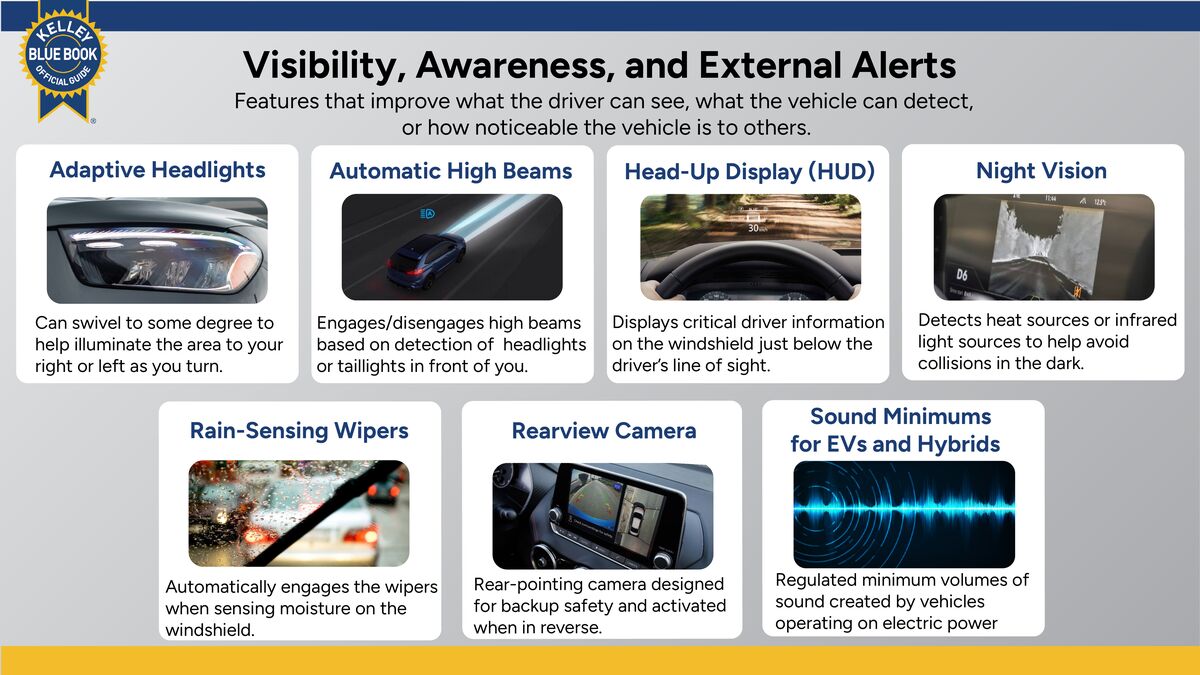
Adaptive Headlights
For the most part, traditional headlights are fixed. That is, they are pointed straight ahead. Some vehicles have a self-leveling feature that compensates for heavy loads that weigh down the rear end. However, they still point straight ahead.
Adaptive headlights, however, can swivel to some degree in response to the direction the steering wheel is turning during cornering. Consequently, these headlights can illuminate the area to your right or left as you turn.
Automatic High Beams
Also called high-beam assist, this technology uses a forward-facing camera or photosensor to detect the headlights of approaching vehicles. It is also programmed to react to taillights that become visible as you close the distance to cars ahead of you.
A driver must initially turn the system on, though automatic high beams will then become the default setting. The high beams remain engaged unless the system detects headlights or taillights ahead at a set distance. The system will then disengage the high beams. When no headlights or taillights are detected, the high beams will reengage.
The system’s ability to disengage and engage the high beams means one less thing for the driver to do manually.
Head-Up Display (HUD)
Designed to reduce the time a driver’s eyes leave the road to check vehicle speed or other vital information, a head-up display helps keep your eyes on the road ahead. A projector on the dashboard at the base of the windshield displays critical driver information just below the driver’s line of sight.
Some HUD systems allow a driver to choose which information to display. This information can include turn-signal repeaters, vehicle speed, next-turn navigation instructions, and so forth. Studies show that using a head-up display can lead to faster reaction times in certain instances and improve driving performance.
Night Vision
Lighting up the night can involve more than just headlights. Night vision is gaining popularity in cars. There are two types: passive and active.
Passive systems use a thermographic camera that detects heat. They can see and display the heat coming off a person, an animal, or any object that’s radiating more heat than the air around it. The camera translates what it sees into a black-and-white image on a monitor.
An active system uses infrared light sources that illuminate the road ahead. Because infrared is outside a human’s visible spectrum, it doesn’t affect oncoming drivers. A special infrared camera gathers the data, displaying images on a monitor.
A passive system has trouble seeing inanimate objects that don’t emit heat. Active systems can fail when infrared light is blocked by fog, snow, or rain.
Rain-Sensing Wipers
When the rain-sensing wiper system senses moisture on the windshield, it automatically engages the wipers. The driver doesn’t need to change the wiper speed as rain volume changes, since the system automatically adjusts.
Rearview Camera
Mandatory in 2018 on all passenger cars, light trucks, and vans.
Sometimes called a backup camera, this rear-facing camera is usually located near a vehicle’s rear bumper, license plate, or the latch for the trunk lid or tailgate.
These cameras are designed for backup safety and are automatically activated when shifting into reverse. Although very effective when backing into or out of a parking spot, rearview cameras are invaluable for spotting pedestrians or other objects behind your vehicle.
Rearview cameras on newer vehicles provide parallel guidelines, marking the vehicle’s width as you back into a parking spot. More advanced versions also display bending guidelines, providing a visual image of your vehicle’s path as you steer into a parking space. Some systems are high-definition. Graphic guidelines often display graduated colors indicating your vehicle’s proximity to the end of the parking space or an object.
Sound Minimums for Electric Vehicles and Hybrids
Mandatory in 2022 for all electric vehicles (EVs) and plug-in hybrid vehicles (PHEVs).
Quiet is wonderful until a pedestrian, biker, or another vehicle moves unknowingly into an EV’s path because it’s operating with a silent electric motor. The regulation sets minimum sound levels for electric-only vehicles and specifies when such sound must be generated.
Driver, Occupant, and Convenience Safety Features
Features such as rear occupant detection and safe exit provide additional layers of protection for drivers and passengers. At the same time, other systems help monitor driver or occupant conditions and can assist with low-speed maneuvers, such as parking.
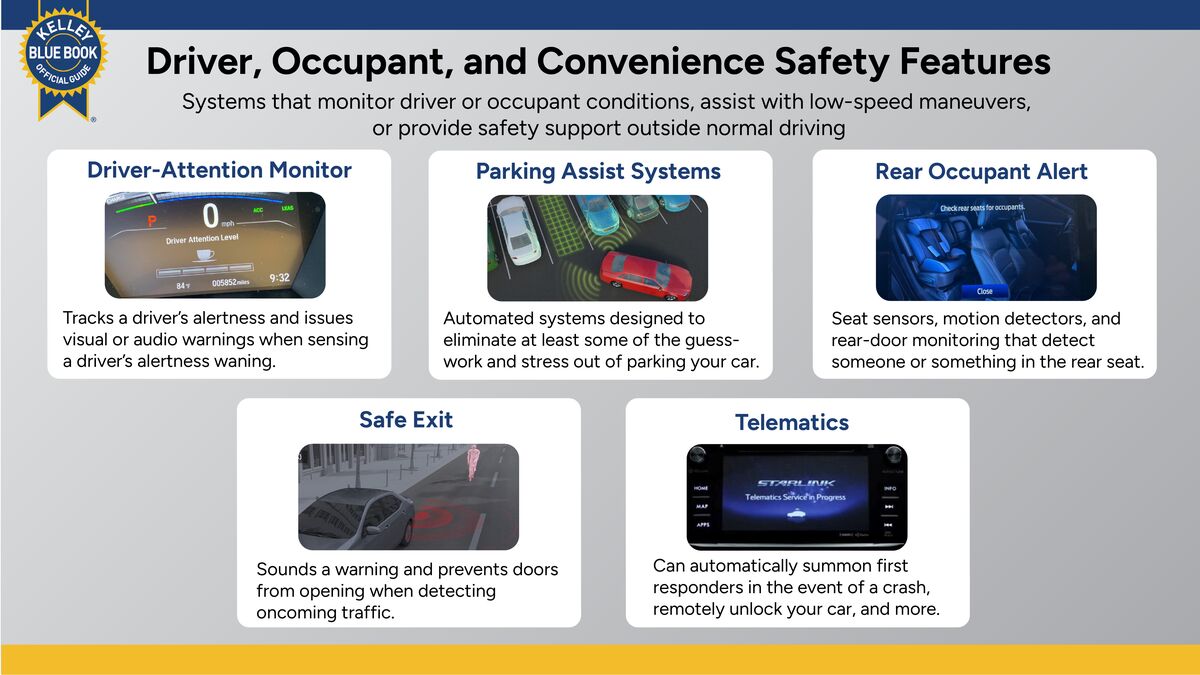
Driver-Attention Monitor
Using a sensor-equipped camera with LED detectors, a driver-attention monitor or drowsiness detection system tracks a driver’s alertness through eye movements, head position, eyelid activity, and so forth. Some more sophisticated versions tie other advanced driver aids into the monitoring to track steering behavior and more.
When the system determines that a driver’s alertness is waning, it issues visual or audible warnings.
Parking Assist Systems
Parking assist systems utilize a variety of automated systems designed to eliminate at least some of the guesswork and stress of parking your car.
These systems offer different levels of automation. Once a space is found, some systems will steer the vehicle into the parking space while the driver operates the pedals. Others will find the spot and then fully park the car. Others will allow the driver to pull up to a diagonal parking spot, step out, and then use the key fob to pull the vehicle into the parking spot.
Other systems allow the driver to summon a parked car to their location.
Rear Occupant Alert
Mandatory in 2025 for all passenger cars.
Several manufacturers install rear-seat reminders to minimize the chance of a child or pet being left in the rear seat. By the end of 2025, expect all passenger cars and SUVs to have this safety technology. Seat sensors, motion detectors, and rear-door monitoring detect a person or object in the rear seat when the ignition is disengaged. If this is the case, a warning sounds.
Safe Exit
Common in Hyundai models and other makes, Safe Exit uses rear-mounted sensors to detect vehicles in a neighboring lane approaching from behind. The system sounds a warning and prevents the doors on that side of the car from opening. Once the danger has passed, the doors will function.
Telematics
When you hear the word telematics, think of the telephone — it’s your car’s way of making emergency calls to outside providers and, like a smartphone, provides many convenience features that improve your life.
Telematics is the marriage of communications and computer data. In vehicles, it involves GPS tracking, cell-phone service, and the vehicle’s computer system. It allows a direct connection between your smartphone, car, and telematics provider. With permission, insurance companies may use telematics to collect data on mileage, speed, and braking for usage-based policies.
Telematics can automatically summon first responders in the event of a crash, remotely unlock your car, locate your vehicle, provide a weather report, or provide turn-by-turn directions. In its more sophisticated forms, telematics may require a subscription.
Editor’s Note: We have updated this article since its initial publication. Russ Heaps contributed to this report.