


Enthusiasts love a powerful car exhaust note, and Kelley Blue Book’s 100th Anniversary presents a great opportunity to look back at how the sounds of the industry have changed over the years. From Formula 1 cars to electric vehicles, automotive exhausts help drivers build a special connection with their rides while working hard to reduce harmful emissions. Let’s dive in.
Sound Wasn’t the Initial Focus
We’ve come a long way from the exhaust systems seen in early automobiles. While they were originally designed solely to carry toxic gases away from passengers, automotive exhausts now come in a wide range of designs, from high-flow performance applications to systems that make electric vehicles (EVs) sound like their gas-powered counterparts.
One of the first automotive exhaust systems was patented in the United States in 1897, but it wasn’t until the 1930s that mufflers became commonplace. With a growing number of cars on the road, noise became a significant problem, pushing auto engineers to develop mufflers with baffles and air chambers to dampen the sound.
Exhaust Sound Samples
Slide through each car and tap play.

2008 BMW M3 V8
Exhaust sample

2023 Toyota GR Supra
Exhaust sample

2026 Ford Mustang Lineup
Exhaust sample

Vintage Honda RA272 F1
Exhaust sample

2027 Mercedes-AMG GLC 53 4MATIC+
Exhaust sample
The Need for Speed Drove Innovation
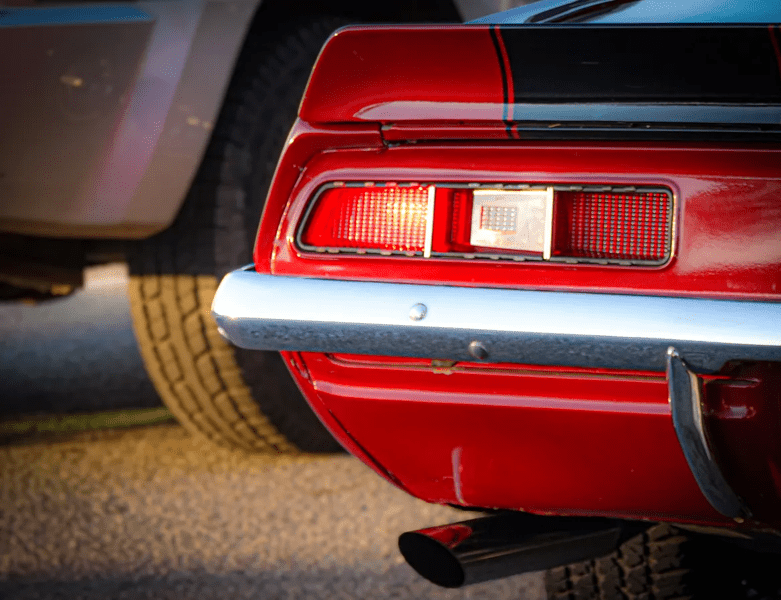
It didn’t take long for tuners and hot-rodders to figure out that a free-flowing exhaust could boost performance, leading to a boom in development in the 1950s. That boom continued into the 1960s and the muscle car era, as American automakers duked it out on the street and drag strip. The hulking V8 engines of the era saw improved fuel economy and power output with performance exhaust systems. However, things took a turn as emissions regulations became tighter later in the decade and into the 1970s.
Federal regulations forced automakers to rethink their exhaust system designs. The catalytic converter helped reduce carbon emissions, but early applications also made it harder to extract the big horsepower numbers buyers had become accustomed to over the previous decade. That change, combined with a push to increase safety standards and badge-engineered vehicle design, led to the “malaise era” in the U.S. auto industry, which lasted until the mid-1980s.
Exhaust technologies evolved as smaller, more fuel-efficient cars became common in the 1980s. While many automakers still struggled to deliver performance, 4-cylinder engines and the more widespread use of turbochargers made it easier to generate usable horsepower without comparable increases in emissions.
The situation improved further in the 1990s and early 2000s as computer components became smaller and less expensive, leading to onboard diagnostic systems with sensors and variable intake systems that could modify the air-fuel mixture on the go.
As someone who reached driving age in the mid-1990s, this era remains my favorite for exhaust designs, as imported cars dominated the enthusiast scene with big pipes on little cars and sounds that tuners still chase today.
Electrification Has Changed the Game
Some of the most notable changes to automotive exhausts over the last century have occurred in the last 20 years. Hybrids, plug-in hybrids (PHEVs), and electric vehicles (EVs) have slashed our reliance on gas engines. With more power coming from the electric side of the equation, many vehicles have smaller, quieter exhaust systems, with PHEVs and EVs operating in near-complete silence much of the time.
Electric motors often deliver significant horsepower and acceleration gains over gas engines, but they don’t generate the sound and level of engagement that many driving enthusiasts expect. In response, some automakers and aftermarket manufacturers have developed synthetic exhaust systems that emulate the sounds of high-performance gas vehicles.
The Dodge Charger Daytona EV uses a unique “Fratzonic” exhaust system that relies on chambers and speakers to generate sounds coordinated with the car’s acceleration and cruising speed. Borla Performance Industries has also developed an upgrade for the Ford Mustang Mach-E that uses the throttle position, wheel speed, and other metrics to simulate a sporty exhaust sound.
David Borla is the Chief Marketing Officer at Borla Performance Industries, which describes itself as “the pioneer and leader in the design and manufacture of stainless steel performance exhaust.” Regarding sound and drivers’ connection to their vehicle, Borla said, “I often say that sound is an instrument in two distinct ways, and that philosophy shapes how we approach performance acoustics. The first way it’s an instrument is like a gauge on your instrument cluster. As humans, we drive primarily with sight, touch, and sound,” he said.
“Sound even overlaps with feel, because frequency and vibration are something you experience physically. In performance driving, engine tone tells you about load, traction, shift points, and timing,” he continued. “Long before digital displays, sound was a primary performance gauge, and it still sharpens reaction time and deepens the connection between driver and machine.”
Borla said drivers also build a sense of identity based on their car’s sound. “The second way sound is an instrument is in the musical sense, and it’s also identity. Throttle input, gear selection, and load shape the note, and a driver can play the car the way they play a musical instrument. That interaction transforms transportation into an experience. The sound becomes part of the vehicle’s personality and the driver’s signature. In car culture, how a vehicle sounds is just as important as how it looks, because it communicates character and intent before you ever see the badge. When engineered correctly, sound is one part telemetry and one part swagger, and that’s what makes a vehicle feel alive.”